The Singing Cowboy Subgenre: A Complete History
From Gene Autry's first guitar strum to Roy Rogers' last television rerun — how the strangest Western subgenre became a billion-dollar industry

If you've never watched one, the premise sounds ridiculous: in the middle of chasing rustlers across the high plains, a cowboy hero stops his horse, pulls a guitar from his saddlebag, and serenades the camera for a solid two minutes. This was the entire commercial logic of the singing cowboy subgenre — and for roughly two decades, it was the most reliable way to fill seats in Saturday matinee theaters across America.
The accidental invention
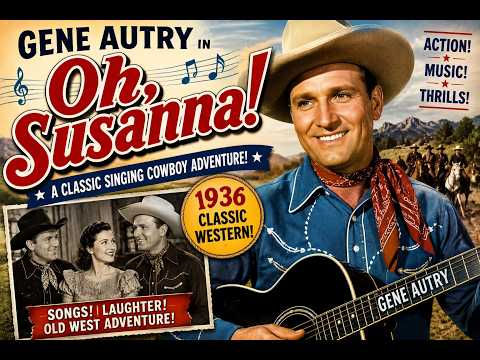
The first true singing cowboy on screen was a kid named Ken Maynard, who sang on horseback in The Wagon Master (1929) — really an excuse for the studio to promote his record sales. But the subgenre as a commercial force was kicked off in 1935 by Gene Autry, who'd been a regional radio star in Chicago before a chance encounter with film producer Nat Levine at a Mascot Studios party led to a screen test. Levine cast Autry in a Ken Maynard picture as comic relief, then quickly realized the kid with the guitar was more bankable than the established star.
Tumbling Tumbleweeds (1935)
Autry's first starring role established the formula. Returning home after years away to investigate his father's murder, Autry plays exactly Gene Autry — a folksy, even-tempered, guitar-strumming young rancher who solves problems with wits, fists, and the occasional song. The picture earned five times its budget. By 1937, Autry was the top-grossing Western star in America.
The Republic Pictures dynasty
Autry's success put him at Republic Pictures, which built the rest of its B-Western roster around the singing-cowboy template. The studio's other major stars worked the same formula:
- Roy Rogers — hired in 1937 specifically as Autry insurance, then promoted to top billing when Autry left in 1938. Rogers' star eclipsed Autry's by the mid-1940s.
- Tex Ritter — country music star turned screen cowboy; made over 60 films in the singing-cowboy mold.
- Bob Wills — Western swing pioneer who starred in his own series of B-Westerns built around his Texas Playboys band.
- Smiley Burnette — the most successful comic-relief sidekick of the era; sang as much as the leads in many pictures.
The formula breakdown
A typical singing-cowboy Western included two to four full musical numbers — usually a campfire ballad, an upbeat trail song, a romantic number for the love interest, and a finale. Songs were carefully chosen to be commercially releasable on tie-in records, often weeks before the film premiered. Autry's Back in the Saddle Again was promoted with the 1939 film of the same name; the song outsold the picture.
The decline
The subgenre died with television in the early 1950s. Why pay a quarter to see Roy Rogers sing on Saturday afternoon when he was free in your living room every Saturday morning? Autry and Rogers both moved their operations to TV by 1951 and never made another theatrical Western. By 1955, the singing-cowboy era was effectively over.
Why these films are now public domain
Republic Pictures sold its library in the early 1960s and copyrights lapsed on many of the singing-cowboy Westerns by the late 1960s. The result: dozens of Gene Autry, Roy Rogers, and Tex Ritter films are now freely available — including some of the highest-quality entries in the subgenre.
Where to start
If you've never watched a singing-cowboy picture, the historical entry point is Tumbling Tumbleweeds (1935) — the film that essentially invented the commercial form. From there, jump to Under Western Stars (1938), Roy Rogers' first major picture and arguably the best produced of the subgenre's early years. Sample widely: the films were made on assembly lines and quality varies, but the highlights still hold up.
The legacy
The singing cowboy looks ridiculous to modern eyes — and was already a punchline by 1955 — but the format invented the multi-platform entertainment franchise. Long before Disney was bundling films with merchandise and music tie-ins, Gene Autry was selling 78s, comic books, lunchboxes, and pony rides all built around a single film property. Every modern entertainment-franchise playbook traces back, in some sense, to a man with a guitar on a horse.