Best Public Domain Westerns of the 1930s
The decade that built the B-Western — singing cowboys, serial heroes, and the studios that supplied them
The 1930s was the decade that built the modern B-Western. The arrival of sound in 1929 had killed off most of the silent Western stars — Tom Mix, Hoot Gibson, Ken Maynard struggled with the transition — and a new generation of cowboy heroes emerged, often defined by what they could do that the silent stars couldn't: sing.
The singing-cowboy era begins
The first singing-cowboy feature is widely cited as In Old Santa Fe (1934), with Ken Maynard as the nominal star and a young Gene Autry as a supporting musical performer. Autry's screen presence overshadowed Maynard's, and Republic Pictures — which had just been formed in 1935 — built its first major franchise around him.
Tumbling Tumbleweeds (1935) launched Autry as a starring lead. Within three years, Republic had a stable of singing cowboys: Autry, Roy Rogers (signed in 1938 as a hedge against Autry), Tex Ritter (originally at Grand National), and dozens of less-famous singing leads.
The Hopalong Cassidy years
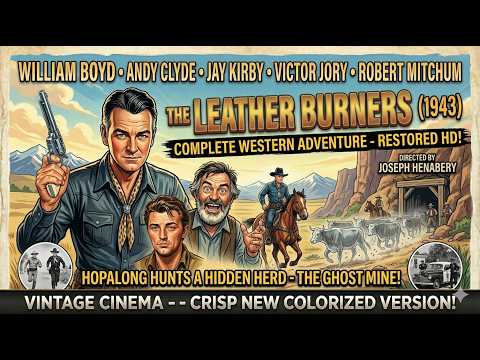
Parallel to the singing-cowboy boom, Paramount launched the Hopalong Cassidy series in 1935 with William Boyd in the lead. The Hoppy films — non-musical, more action-oriented, with their distinctive Bar 20 ranch setting — eventually ran to 66 features and outlasted nearly every other 1930s Western series.
The essential 1930s public-domain Westerns
In Old Santa Fe (1934) — The film that introduced Gene Autry. Ken Maynard is the credited star, but Autry's musical numbers steal the picture and signaled the future of B-Westerns.
Tumbling Tumbleweeds (1935) — Autry's first starring vehicle. Established the singing-cowboy formula that would dominate the decade.
The Phantom Empire (1935) — A Mascot Pictures 12-chapter serial starring Autry. The premise is bizarre: Autry plays himself, a singing cowboy who discovers an underground science-fiction civilization beneath his ranch. The genre mashup somehow works, and the serial is a cult favorite.
Hop-Along Cassidy (1935) — William Boyd's first Hopalong entry. Establishes the character's iconic look — black-clad, courtly, morally upright.
Under Western Stars (1938) — Roy Rogers's debut as a leading man. Oscar-nominated for Best Song. The Rogers screen persona arrives essentially fully formed.
Song of the Gringo (1936) — Tex Ritter's debut starring vehicle. Grand National Pictures. A solid example of the early-Ritter style.
Riders of Destiny (1933) — Early John Wayne B-Western at Monogram. Wayne's stardom was still six years away, but his on-screen presence is already distinctive.
The B-Western economy
1930s B-Westerns were churned out by the dozen. Republic, Monogram, Mascot, Grand National, PRC, and a host of even smaller producers all maintained Western units. Budgets ran $15,000 to $40,000. Shooting schedules were five to ten days. Stars were under contract for six or eight pictures a year.
The result was a vast output. By 1938, an active fan could watch a new B-Western every week without exhausting the major studios' production. The economic structure of B-Westerns — fast, cheap, formula-driven — eventually became the model for television Westerns of the 1950s.
Why so many are public domain
The studios that produced 1930s B-Westerns — Republic, Monogram, Mascot, Grand National, PRC — all eventually folded or merged. As corporate continuity collapsed, copyright maintenance lapsed. By the 1960s, when the 28-year renewal dates came due, most of these companies no longer existed or didn't bother filing. The result: a huge percentage of 1930s B-Westerns is now in the public domain.
Where to start
Start with Tumbling Tumbleweeds (1935) to see the singing-cowboy formula at its origin. Then watch Hop-Along Cassidy (1935) to see the non-musical alternative. Together they map the two main branches of 1930s B-Western production.