Sherlock Holmes Public Domain Films: Basil Rathbone and Beyond
How Conan Doyle's detective became one of the most-filmed characters in Hollywood history

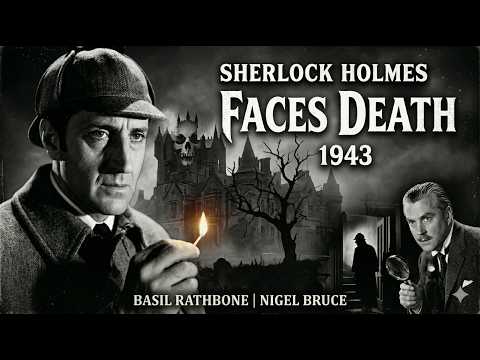
Arthur Conan Doyle's detective Sherlock Holmes is the most-filmed fictional character in cinema history — over 250 actors have played him on screen since 1900. The most iconic interpretation, however, belongs to Basil Rathbone, who played the detective in 14 features between 1939 and 1946 alongside Nigel Bruce as Dr. Watson.
The Rathbone era
The 14 Rathbone Holmes films break neatly into two phases:
Fox (1939–1939, two features) — The Hound of the Baskervilles (1939) and The Adventures of Sherlock Holmes (1939). Both are period-set in Victorian England. They remain under Fox/Disney copyright.
Universal (1942–1946, 12 features) — Universal acquired the rights and updated Holmes to contemporary 1940s settings, often involving Nazi espionage and other wartime intrigues. Most of the Universal entries fell into the public domain through non-renewal in the late 1960s.
The essential public-domain Rathbone Holmes
Sherlock Holmes and the Voice of Terror (1942) — The first Universal entry. Holmes battles Nazi propagandists broadcasting from a secret transmitter. The wartime setting was controversial at the time (Holmes purists hated the modernization), but the picture moves cleanly.
The Spider Woman (1943) — Gale Sondergaard as Adrea Spedding, who masterminds a series of "suicides" that aren't suicides. Sondergaard's villainess is one of the great unsung Holmes adversaries.
The Scarlet Claw (1944) — Often called the best Universal Holmes. A foggy Canadian village, a murder mystery with possible supernatural overtones. The atmosphere rivals contemporaneous Val Lewton horror productions.
The Pearl of Death (1944) — Rondo Hatton (the actor with acromegaly who became Universal's grotesque heavy) co-stars as the Hoxton Creeper, a murderer with crushing strength. One of the most memorable supporting villains in any classical-Hollywood detective film.
Dressed to Kill (1946) — The final Rathbone Holmes. Patricia Morison plays a villainess decoding stolen Bank of England plates from the tunes encoded in music boxes. The mystery is one of the most elegantly constructed of the series.
Pre-Rathbone Holmes
Holmes had been filmed extensively before Rathbone. Eille Norwood made 47 short Holmes films at Stoll Pictures (UK) between 1921 and 1923. Many of those silent shorts are in the public domain and circulate on archive sites. They're technically primitive but historically fascinating.
William Gillette, the American stage actor who originated the deerstalker-cap-and-curved-pipe image of Holmes, made one 1916 silent feature based on his stage adaptation. Long considered lost; rediscovered in 2014 in the Cinémathèque Française. Now in the public domain.
The Rathbone interpretation
What made Rathbone's Holmes definitive wasn't fidelity to Conan Doyle — the Universal pictures took enormous liberties with the source material. It was Rathbone's bearing: cold, precise, intellectually impatient, and emotionally guarded. Combined with Nigel Bruce's bumbling, warm-hearted Watson (much sillier than the Conan Doyle character), the dynamic worked. Every subsequent Holmes screen interpretation — Jeremy Brett, Benedict Cumberbatch, Robert Downey Jr. — has had to work in relation to Rathbone.
Where to start
Start with The Scarlet Claw (1944) for the best single Universal Holmes. From there, try The Pearl of Death (1944) for Rondo Hatton's unforgettable villain, then Dressed to Kill (1946) for the most cleanly constructed mystery in the series.