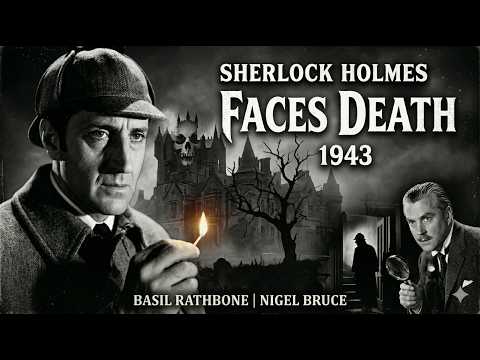
The Adventures of Sherlock Holmes (1939): Basil Rathbone's Defining Performance
The second Fox Sherlock Holmes feature — and the picture that crystallized the canonical screen Holmes

The Adventures of Sherlock Holmes (1939) was Basil Rathbone's second feature as Sherlock Holmes — released by 20th Century-Fox just six months after the company's The Hound of the Baskervilles (1939). The two pictures launched the most enduring screen interpretation of Holmes in cinema history. Rathbone went on to play Holmes in 14 features total (the two Fox pictures plus 12 Universal productions, 1942-1946) and four years of weekly radio broadcasts. The 1939 Fox pictures are the canonical Holmes performances — Rathbone at his sharpest, the productions at their highest budgets, the screenplays at their most faithful to Conan Doyle.
The premise
Adapted loosely from William Gillette's 1899 stage play Sherlock Holmes. Holmes investigates the murder of Lloyd Brandon (Peter Willes), apparently killed for inheritance reasons by his cousin Ann (Ida Lupino). As Holmes investigates, he gradually uncovers the involvement of Professor Moriarty (George Zucco) — the great criminal mastermind of Conan Doyle's stories — in an elaborate plot to steal the Crown Jewels.
The screenplay isn't directly adapted from any single Conan Doyle story. The picture combines elements from multiple Holmes stories with original material from the Gillette stage adaptation. The result is a feature-length Holmes adventure that uses Conan Doyle's character framework while telling a new story.
The Basil Rathbone performance
Basil Rathbone was 47 years old when The Adventures of Sherlock Holmes was filmed. He had been a working actor since the late 1920s but had not yet found a defining screen role. The Holmes performances changed his career — he became permanently identified with the character to the point that his subsequent career struggled with the typecasting.
Rathbone's Holmes is intellectually superior, emotionally controlled, and physically capable. He performs the detective's classic mannerisms — the deerstalker hat, the curved pipe, the impatience with slower minds — with theatrical precision that subsequent Holmes performers have either imitated directly or deliberately rejected. Every subsequent screen Holmes interpretation (Jeremy Brett, Robert Downey Jr., Benedict Cumberbatch, Jonny Lee Miller) exists in relation to the Rathbone version.
The Nigel Bruce Watson
Nigel Bruce as Dr. Watson is one of the most controversial elements of the Rathbone-era Holmes adaptations. Bruce played Watson as substantially more bumbling and less intellectually capable than Conan Doyle's source character. The original Watson was a former military doctor with substantial professional accomplishments; Bruce's Watson is a comic-relief sidekick who frequently misunderstands Holmes's investigative reasoning.
Modern Holmes scholarship has been increasingly critical of the Bruce interpretation. The 1984 Granada TV series with Jeremy Brett (Watson played by David Burke and later Edward Hardwicke) was specifically intended to restore the Watson character to dignity by treating him as the intelligent professional Conan Doyle had originally written.
The Ida Lupino performance
Ida Lupino was 21 years old when she played Ann Brandon. She was already a working Hollywood actress with substantial supporting roles, but the Holmes picture gave her her first significant lead in a major studio production. Lupino's Brandon is more emotionally complex than the typical 1939 Holmes-feature ingenue — the character has secrets, internal conflicts, and morally ambiguous loyalties. Lupino plays the role with substantial subtlety.
Lupino would later become one of the few female directors of classical Hollywood — directing seven feature films between 1949 and 1966 including The Hitch-Hiker (1953), one of the strongest film noirs of the early 1950s. Her career trajectory from leading lady to director was unusual for the era.
The George Zucco Moriarty
George Zucco as Professor Moriarty plays the great Holmes adversary with theatrical menace. Moriarty appeared in only two Conan Doyle stories — "The Final Problem" (1893) and The Valley of Fear (1915) — but became the canonical Holmes villain through subsequent adaptations. Zucco's interpretation is foundational; subsequent screen Moriartys (Henry Daniell in the 1945 The Woman in Green, Andrew Scott in BBC Sherlock, Jared Harris in Guy Ritchie's Sherlock Holmes: A Game of Shadows) all reckon with the Zucco template.
The Fox era vs the Universal era
Rathbone made 14 Holmes features total. The first two — The Hound of the Baskervilles (1939) and The Adventures of Sherlock Holmes (1939) — were 20th Century-Fox productions with period (1880s London) settings and substantial budgets. The subsequent 12 — produced by Universal between 1942 and 1946 — were lower-budget productions set in contemporary 1940s London, with Holmes investigating WWII-era conspiracies and Nazi plots.
Most viewers consider the Fox pictures the most artistically substantial of the Rathbone Holmes catalog. The 1939 Adventures is in particular widely regarded as the strongest single Rathbone Holmes feature.
Public-domain status
The Adventures of Sherlock Holmes (1939) is in the public domain through Fox's failure to renew the copyright. The 1939 Hound of the Baskervilles remains under Fox/Disney copyright. The 12 Universal Holmes pictures (1942-1946) are mostly in the public domain through Universal's complicated post-1956 rights handling.
The Conan Doyle copyright
The underlying Conan Doyle Holmes stories are now in the public domain in most jurisdictions. The Conan Doyle Estate's attempts to maintain copyright control over specific Holmes characterizations and story elements have generally failed in U.S. courts. The character is essentially free for new adaptations as of the 2020s.
Where to start
Watch The Adventures of Sherlock Holmes (1939) in the highest-quality restoration available. The 85-minute runtime is accessible for a single viewing. Rathbone's performance rewards careful attention — particularly the early-act establishment of the Holmes character through small physical and vocal choices that subsequent scenes pay off. The picture is essential viewing for anyone interested in Holmes screen history.