Hopalong Cassidy Films: The Complete Free Watching Guide
The silver-haired, black-clad cowboy who became one of Hollywood's biggest stars — and a marketing empire
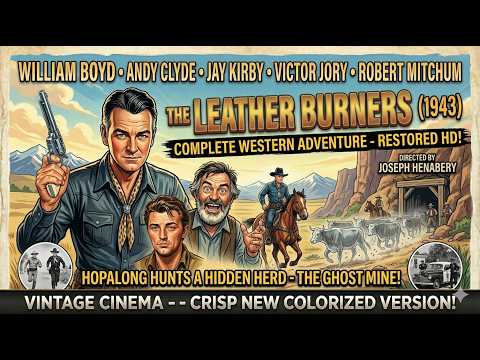
If you only watch one B-Western series in your life, make it Hopalong Cassidy. The 66 films William Boyd made as the silver-haired rancher between 1935 and 1948 are arguably the highest-quality work in the entire B-Western catalog, and most of them are now in the public domain.
Origin: from pulp page to screen
Hopalong Cassidy started as a character in a 1904 Clarence E. Mulford novel — a hard-drinking, hard-cussing, hard-fighting wrangler with a limp ("hop-along"). When producer Harry "Pop" Sherman acquired the screen rights in 1935 and cast William Boyd, he scrubbed the character of every rough edge. Cassidy became a teetotaling, even-tempered, white-hatted (well, white-hat-on-black-outfit) moral exemplar. The limp went away. The cussing went away. What remained was a thinking-man's cowboy hero who solved problems with wits before fists.
The Boyd transformation
William Boyd was a former silent-film leading man whose career had cratered after a scandal (a different actor with a similar name had been arrested at a wild party; the newspapers ran Boyd's picture by mistake). At 40, he was washed up. The Hopalong Cassidy role was supposed to be a one-off bit part — but Boyd insisted on playing it differently than the books, and Sherman let him have it. He played Hoppy for the next 17 years and never broke character publicly.
The formula
Cassidy works the Bar 20 Ranch alongside two sidekicks (originally James Ellison and George "Gabby" Hayes; later Russell Hayden, Andy Clyde, and finally Rand Brooks). Most films involve cattle rustling, water rights, kidnapping, or stolen mortgages — but the production values are notably higher than competitor B-Westerns. Sherman shot on location. Sherman hired real composers. Sherman invested in costumes (Hoppy's all-black wardrobe was unique in 1935). The films feel made, not assembled.
Where to start
The first film, Hopalong Cassidy (1935), is an essential entry point. Boyd's Cassidy is more rough-edged here than he'd become later (he actually does drink in this one), but the basic formula is already locked in. From there:
- Bar 20 Rides Again (1935) — the second entry and arguably the best of the Paramount years
- Three on the Trail (1936) — introduces Gabby Hayes' more polished sidekick persona
- Heart of Arizona (1938) — late-period Paramount, gorgeous location work
- Hopalong Cassidy Returns (1936) — the only entry where Hoppy gets a love interest who matters to the plot
The independent era (1942–1948)
When Sherman left Paramount in 1942, Boyd bought the character rights outright and produced the final twelve films independently. These pictures are leaner and rougher than the Sherman entries — smaller budgets, shorter runtimes, more obvious back-lot Western towns — but they still bear Boyd's careful, dignified performance. Hoppy never compromised, even when his pictures did.
The TV miracle
In 1948, Boyd made a bet that nobody else in Hollywood was making: he bought the rights to all 66 Hopalong Cassidy films and sat on them. When NBC came looking for content for the new medium of television in 1949, Boyd licensed the films back to them. Within months, Hoppy was the most popular thing on television. The character spawned the first wave of TV-driven merchandising — Hopalong Cassidy lunchboxes, Hopalong Cassidy bicycles, Hopalong Cassidy roller skates. Boyd reportedly made $70 million in merchandising royalties between 1949 and 1953. Not bad for a washed-up silent-film actor who took a one-off role 14 years earlier.
Why they're public domain
When Boyd died in 1972, the rights to his Hopalong Cassidy library passed through a tangled chain of successors who often failed to renew copyrights in time. The result: roughly half the Cassidy films are now firmly in the public domain, freely available on archives like ours. The others remain in copyright limbo — technically protected but rarely enforced, since the rights-holders themselves are sometimes hard to identify.
The bottom line
Hopalong Cassidy films aren't just better than the average B-Western — they're the closest thing the subgenre produced to genuine art. William Boyd took a role he didn't want, played him as a moral exemplar, and built one of the great character actors of his era. If you've never seen a Cassidy film, you're in for a treat. Start with the 1935 original and just keep going — it's hard to find a bad entry.

