The Golden Age of B-Westerns: 1935-1945
A decade when Hollywood made a B-Western a week and Saturday matinees ruled American childhood
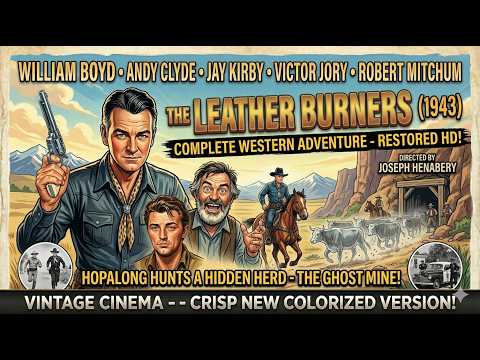
Hollywood's golden age of B-Westerns ran from roughly 1935 — when Republic Pictures was founded and the singing-cowboy formula crystallized — to roughly 1945, when the postwar economy and the looming threat of television began to erode the assumptions on which the entire industry was built. In that ten-year window, Hollywood produced approximately 700 B-Western feature films. The vast majority of them are now in the public domain.
The economics
The B-Western worked because of how movies were exhibited in the 1930s. A typical theater showed a double bill — an A-list feature plus a B-picture programmer — and changed the program two or three times a week. Theaters needed an enormous, constantly-refreshing supply of programmers, and Western was the genre that filled the demand most reliably. Republic, Monogram, PRC, and the other Poverty Row studios all built their business models on the math: a $25,000 production budget, a 5-day shoot, a 55-minute runtime, a $75,000 gross. Repeat 30 times per year.
The Saturday matinee phenomenon
Every small-town theater in America ran a Saturday matinee. Kids paid a nickel or a dime, ate popcorn, watched a B-Western, then watched a serial chapter, then watched cartoons. The B-Western was specifically optimized for this audience: clear good-guys-versus-bad-guys plots, no romance (or romance pushed to a perfunctory subplot kids could ignore), lots of action, and runtimes short enough that the whole program ended before dinnertime.
The factories
Four studios dominated B-Western production:
- Republic Pictures (founded 1935) — highest production values, biggest stars (Autry, Rogers, the Mesquiteers). Released 50-70 Westerns per year through the decade.
- Monogram Pictures (founded 1931) — lower budgets, stars like Tim McCoy, Bob Steele, Tex Ritter. Released 30-40 Westerns per year.
- PRC (Producers Releasing Corporation) (founded 1939) — the lowest budgets, lowest quality, but high volume. Buster Crabbe Westerns, the Lone Rider series.
- Columbia (major studio, but ran a B-Western unit) — Charles Starrett, Tim McCoy, the Durango Kid. Higher production values than Monogram or PRC.
The stars
The decade made household names of a dozen B-Western leads — Gene Autry, Roy Rogers, William Boyd, John Wayne (briefly), Tex Ritter, Buck Jones, Tim McCoy, Bob Steele, Buster Crabbe, Hoot Gibson, Ken Maynard, Tom Mix (in his declining years). Each had a recognizable screen persona, a stable of recurring sidekicks, often a horse with its own billing, and a merchandising line aimed at the Saturday matinee audience.
The formula evolution
By 1935, the B-Western formula was settled: contemporary or near-contemporary setting (1880s-1920s, rarely earlier), a corrupt rancher or businessman as the villain, a wronged hero who returns to set things right, three or four action setpieces, a perfunctory romance, a comic-relief sidekick, and a clean moral conclusion. By 1945, the formula had refined into something almost lyrical — a kind of folk-mythology shorthand that audiences understood instantly. The best 1945 B-Westerns are tighter, smarter, and more visually accomplished than the 1935 entries — and they're still made of the same parts.
The decline
Several factors ended the golden age simultaneously around 1948-1950:
- Television — Hopalong Cassidy on TV in 1949 meant kids no longer needed to go to a theater to see the same Western they could see at home
- The end of the studio system — Paramount lost the 1948 antitrust case that forced studios to sell their theater chains, which broke the double-bill economics that made B-pictures viable
- Audience tastes — postwar audiences wanted bigger, more morally complex Westerns (which Howard Hawks, John Ford, and Anthony Mann obligingly delivered)
The legacy
By 1955, the B-Western was essentially extinct. Republic released its last one in 1959. The genre's mass-production era was over — but the films themselves never disappeared. Most are now in the public domain, watchable on archives like ours, and they remain a fascinating window into a vanished mode of American filmmaking. Watching twenty B-Westerns in a row teaches you more about American cultural mythology than any history textbook.


