Gene Autry: The Singing Cowboy Who Defined the Western
How a railroad telegraph operator with a guitar became Hollywood's first true multimedia star

Gene Autry is the only entertainer in history to have five stars on the Hollywood Walk of Fame — one each for film, radio, television, recording, and live theater. He earned them across a career that began behind a railroad telegraph key in Oklahoma and ended with him owning the California Angels. In between, he changed the economics of the American Western — and most of his early film work is now in the public domain.
The Oklahoma kid
Orvon Grover Autry was born in 1907 in Tioga, Texas, and worked as a railroad telegraph operator in Chelsea, Oklahoma during his teens and early twenties. Legend has it that humorist Will Rogers stopped to send a telegram one night, heard Autry singing to himself between messages, and told him he should be on stage. Whether or not the story is literally true, Autry took the advice — and by 1928 he was singing on Tulsa radio.
Movie debut
Autry's screen career began as a curiosity. Producer Nat Levine at Mascot Studios cast him as a singing telegraph operator in In Old Santa Fe (1934), a Ken Maynard vehicle. Autry got one song. Audiences went wild. By the next year, Mascot was building a starring vehicle around him — Tumbling Tumbleweeds (1935) — and the singing-cowboy era was on.
The Republic years
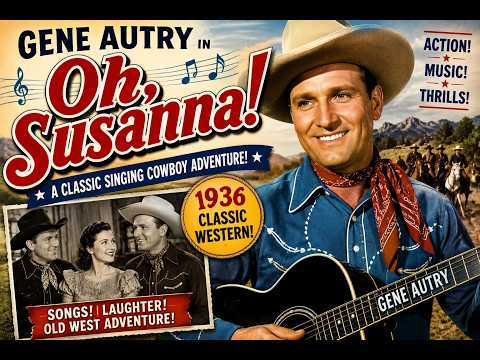
When Mascot merged into Republic Pictures in 1935, Autry came along. Over the next seven years, he made roughly fifty films for the studio — including Sagebrush Trail, Public Cowboy No. 1, South of the Border, and dozens more. The formula was rigid: contemporary setting, three or four songs per picture, comic-relief sidekick (usually Smiley Burnette), villain who underestimates the easygoing hero. Most ran 55-60 minutes and earned three to five times their production cost.
The wartime break
Autry enlisted in the Army Air Forces in 1942 — at the height of his stardom — and spent World War II flying transport planes over the Himalayas. When he returned to Republic in 1946, he found that Roy Rogers had effectively replaced him as the studio's top Western star. Autry made a few more pictures for Republic, then in 1947 launched his own production company, Flying A Pictures, to produce films through Columbia. The Flying A pictures are arguably more accomplished than his Republic work — better production values, more interesting plots, and Autry's most relaxed performances.
The TV pivot
Autry was one of the first major film stars to embrace television. The Gene Autry Show ran on CBS from 1950 to 1956, with Autry essentially playing himself in 91 thirty-minute Westerns. He also produced TV series starring other people — Annie Oakley, The Range Rider, Buffalo Bill, Jr. — and built one of the first independent television production empires.
The business empire
By the 1960s Autry had effectively retired from performing and turned to business. He bought the Los Angeles Angels (later California Angels) in 1961 and remained their owner until his death in 1998. He owned hotels, radio stations, music publishing, and the Autry Museum of the American West. His personal worth at death was estimated at over $300 million.
Why his films are public domain
Most of Autry's Republic-era films had their copyrights lapse in the 1960s when the studio's library was repeatedly sold off. The Columbia-era Flying A pictures remain in mixed copyright status. The TV series is generally still protected. The result: the vast majority of his theatrical work — the singing-cowboy pictures that made him famous — is freely available to watch online.
The cultural legacy
Autry recorded over 600 songs and wrote or co-wrote about 300. Rudolph the Red-Nosed Reindeer (1949), Here Comes Santa Claus (1947), and Frosty the Snowman (1950) are all Autry signature recordings still played every Christmas. He sold more than 100 million records in his lifetime. The Autry Museum in Los Angeles preserves his legacy and the broader history of the American West.
Where to start with his films
If you've never watched a Gene Autry picture: Tumbling Tumbleweeds (1935) is the historic starting point. The Old Corral (1936) features Roy Rogers in an early bit part. South of the Border (1939) shows the formula at its most refined. None of these films are great cinema in the prestige sense — but they're the foundation of an entire industry that built itself around an Oklahoma kid with a guitar and a friendly smile.