Annie Oakley: Television's First Cowgirl Hero
Gail Davis starred as the sharpshooter in three seasons and 81 episodes of late-1950s Western adventure
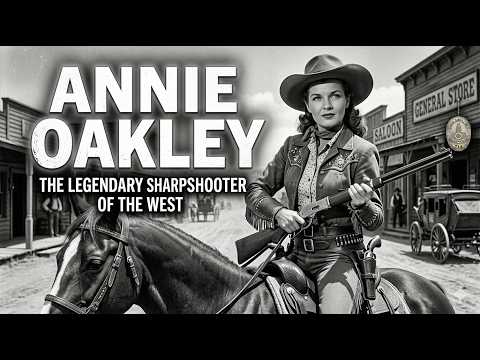
Annie Oakley was American television's first female-led Western — and remains one of the most-watched syndicated series of the late 1950s. Gail Davis starred as the legendary sharpshooter for three seasons and 81 episodes between January 1954 and February 1957. The series was produced by Gene Autry's Flying A Productions and inherited much of Autry's production approach, supporting cast, and Western sensibility.
The real Annie Oakley
The historical Annie Oakley (born Phoebe Ann Mosey in 1860) was the most famous sharpshooter of the 19th century. She became a star with Buffalo Bill's Wild West Show in the 1880s and toured Europe and America for over 17 years. Her precision shooting (she could shoot a dime from someone's outstretched hand from 90 feet away) made her a national celebrity. She died in 1926 at age 66.
The TV series wasn't a biography of the real Annie. The producers used the famous name and the sharpshooter premise but invented an entirely fictional young woman who lived in fictional Diablo, Arizona, with her younger brother Tagg (Jimmy Hawkins) and worked alongside Deputy Sheriff Lofty Craig (Brad Johnson) to keep the peace. The premise let the show tell action-adventure stories that the historical Annie's actual life wouldn't have supported.
Gail Davis and the Flying A connection
Gail Davis had been working in Gene Autry's films since 1949 — appearing in over 14 Autry features in supporting roles. When Autry's Flying A Productions launched Annie Oakley in 1954, Davis was the natural choice for the lead. Her real-life riding and shooting skills (developed during her years in Autry's productions) made her one of the most physically capable Western stars in 1950s television. Davis performed many of her own riding stunts and most of her own shooting sequences (often using prop guns that were modified to fire actual blanks for visual realism).
The format
Each episode ran approximately 25 minutes and followed a predictable adventure structure: Annie and Lofty would encounter a problem in or near Diablo (cattle rustlers, outlaws, kidnappers, mining-claim disputes), Annie would investigate using her sharpshooting and detection skills, and the episode would resolve with the problem solved and the bad guys captured. Most episodes ended with a chase sequence and a final standoff in which Annie's shooting skills saved the day.
The series was deliberately wholesome — aimed primarily at family audiences in syndicated daytime and Saturday-morning slots. There was minimal violence (gunshots typically disabled rather than killed villains), no romantic tension between Annie and Lofty (the production team kept the Lofty-Annie relationship deliberately platonic to avoid distracting from the action), and clear moral lessons in most episodes.
The young-audience target
Annie Oakley was one of the most-watched programs on American Saturday-morning and after-school television in the mid-1950s. The Annie character became a major marketing phenomenon — Annie Oakley toys, lunch boxes, costumes, and books moved millions of dollars in merchandise. For a generation of young girls in the mid-1950s, Annie Oakley was one of the few female action-hero figures available on screen.
The Flying A production approach
Gene Autry's Flying A Productions operated as an unusually efficient television-Western production house. The company produced Annie Oakley, The Range Rider, Buffalo Bill, Jr., The Adventures of Champion (about Autry's famous horse), and several other Western series in parallel. All used overlapping casts, the same production crews, the same California shooting locations, and similar visual conventions. The Flying A operation was one of the most prolific television-Western producers of the 1950s.
The end of the series
Annie Oakley ended after three seasons not because of ratings (the show remained successful) but because Flying A Productions wound down its TV-series operation in 1957. Autry was personally pivoting toward business interests (broadcasting, real estate, eventually professional baseball) and away from active TV production. Davis continued acting in TV guest roles and Western feature films through the 1960s. She died in 1997 at age 71.
The legacy
Annie Oakley's significance as TV's first female-led Western has been increasingly recognized in recent decades. The show predated by years the female-led TV Westerns of the 1960s and beyond, and its commercial success demonstrated that female protagonists could anchor action-adventure programming when properly produced.
Essential episodes
Annie and the Six O Spades — A poker-related mystery that showcases Annie's investigative skills as much as her shooting.
Annie Calls Her Shots — A meta-episode about Annie's reputation as a sharpshooter.
Annie and the Texas Sandman — Mystery-investigation episode with a strong supporting villain.
Annie Finds Strange Treasure — Treasure-hunting plot that demonstrates the series's adventure-story range.
Public-domain status
A substantial portion of Annie Oakley's 81-episode run has lapsed into the public domain through complicated post-Flying A rights handling. Our archive collects 50 episodes — covering most of the canonical entries.
Where to start
Start with any first-season episode for the cleanest expression of the series's format. Annie Calls Her Shots is one of the most-cited entries. Annie Oakley remains one of American television's most important early female-led series.


