Tom Mix: The Original Cowboy Movie Star
Before Wayne, Rogers, and Autry, the highest-paid Western star in Hollywood died alone in an Arizona car wreck at 80 mph

Before John Wayne. Before Roy Rogers. Before Gene Autry. Before Hopalong Cassidy. There was Tom Mix — the original cowboy movie star, the highest-paid actor in Hollywood for most of the 1920s, and the template every Western hero who followed would borrow from. He made 291 films, mostly silent, and his death in 1940 marked the symbolic end of the first chapter of American Western cinema.
The real cowboy
Mix's biography became hopelessly tangled with his publicists' inventions — he claimed at various times to have served in the Boer War, the Boxer Rebellion, and the Spanish-American War, none verifiably true. What is true: he was a former Texas Ranger, a one-time Oklahoma City night marshal, a championship rodeo rider, and a working ranch hand for years before he ever stood in front of a camera. Unlike most of his Western successors, the cowboy persona Mix sold to audiences was something he'd actually lived.
The Selig years
Mix's screen career started in 1909 with Selig Polyscope, an early film company that hired him as a livestock wrangler and quickly noticed he was natural in front of the camera. By 1913, he was starring in his own one-reel Westerns. By 1917, he had moved to Fox Film Corporation, where producer William Fox built his entire studio's marketing around Mix.
The Fox years (1917-1928)
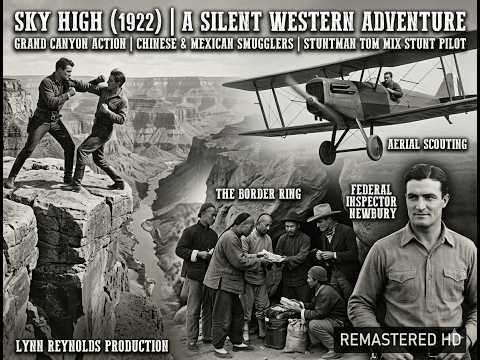
This was the peak of Mix's stardom. Fox spent enormous money making Tom Mix vehicles — location shoots in Wyoming and Arizona, real stunts, elaborate sets. The pictures were aimed squarely at children: Mix never drank, never smoked, never killed if he could avoid it, always rescued the kidnapped girl, always rode off into the sunset. The formula was so successful that by 1925 Mix was earning $17,500 per week — equivalent to over $300,000 per week today.
The horses
Mix worked with several horses throughout his career, but Tony the Wonder Horse (1914-1942) is the one fans remember. Tony was a registered Morgan and could perform tricks that no movie horse before or since matched. Mix taught him to count, to limp on command, to roll over, to gallop in a circle around a fallen rider, and to perform what trainers today would call "liberty work" — moving freely without a halter or lead. Tony retired from the screen in 1932 and lived another decade in semi-retirement.
The sound transition
Mix's career was hurt by the arrival of sound. He was 50 years old in 1930, had spent decades doing his own dangerous stunts, and his body was breaking down. He made nine sound Westerns (Destry Rides Again in 1932, The Fourth Horseman, Hidden Gold, several others) before retiring from films in 1935. The talkies, ironically, may have damaged the Mix legend more than his age did — his speaking voice was thinner and higher than fans had imagined.
The serial
Mix's last screen work was the 1935 Mascot serial The Miracle Rider — fifteen chapters of preposterous adventure as Mix played a Texas Ranger battling "Zarof," a villain trying to steal the secret of an explosive metal from Indigenous tribes. The serial is genuinely fun, kept brisk by director Armand Schaefer, and gave Mix the final cinematic showcase his decade-long career deserved.
The death
Mix died on October 12, 1940, driving alone through the Arizona desert at approximately 80 miles per hour. His car (an immaculate 1937 Cord 812 phaeton) hit a washed-out section of highway, flipped, and threw him from the vehicle. An aluminum suitcase in the back seat — reportedly containing cash and traveler's checks — struck him in the back of the neck and broke it. He was 60. The site of the accident is now marked by a memorial in Florence, Arizona, including a riderless horse statue.
The lasting influence
Everyone who came after — Wayne, Rogers, Autry, Cassidy, the Mesquiteers — borrowed from the Mix template. The white hat (Mix's was actually black in many films, but white in publicity stills). The trick horse. The strict code of conduct. The friendly relationship with Indigenous characters. The juvenile-audience focus. The merchandising tie-ins (Mix had his own breakfast cereal in 1933). All of it traces back to Tom Mix.
Why his films are hard to find
Tragically, most of Mix's films are lost. Of the 291 he made, only about 90 are known to survive in any form, and many of those exist only in deteriorating prints. The 1937 Fox vault fire destroyed roughly half of his Fox-era output. The Selig and earlier silent work fared worse. What's left in the public domain — primarily the sound features and the 1935 serial — gives you a window into the era but doesn't approach the breadth of his actual filmography.
Where to start
If you've never seen a Tom Mix film: The Miracle Rider (1935) is the most reliably available and surprisingly entertaining. From there, Destry Rides Again (1932 Mix version, not the more famous 1939 James Stewart remake), Hidden Gold (1932), and The Texas Bad Man (1932) round out his sound-era work. They won't show you the silent star at his peak — that footage is mostly lost forever — but they'll give you the texture of the original American cowboy movie star, working in his final decade, still the template for everyone who followed.