Tom Mix and the Birth of the Movie Cowboy
Before John Wayne, before Roy Rogers — there was Tom Mix

Before John Wayne, before Roy Rogers, before Gene Autry — there was Tom Mix. Between 1909 and 1935, Mix made 291 films. He was the most popular Western star of the silent era and remained popular through the early sound period until his death in 1940. Many of his silent features are now in the public domain.
The man behind the legend
Mix's actual biography is muddier than the version Hollywood promoted. The studio claimed he'd served in the Spanish-American War, fought in the Boer War, served as a Texas Ranger, and been a sheriff in Oklahoma. His actual service was as a U.S. Army artilleryman who never deployed overseas; the rest was largely fabricated for studio publicity. What's verified: Mix worked as a real cowboy in Oklahoma, performed in Wild West shows, and developed actual horsemanship and rope-work skills that gave his on-screen presence its authority.
The Mix style
Mix's screen persona established the conventions later Westerns inherited:
1. The white-hat hero. Mix nearly always wore an enormous white Stetson and elaborate cowboy attire. This visual shorthand for moral clarity was largely his innovation.
2. The horse as co-star. Mix's horse Tony was billed in the credits, received fan mail, and was the subject of merchandise. The convention of the named, personality-rich horse (Trigger, Champion, Silver) traces directly back to Tony.
3. The stunt focus. Mix did his own stunts and centered his pictures around them. Where William S. Hart's silent Westerns had emphasized character and atmosphere, Mix emphasized action.
The Fox era
Mix's peak years (1917–1928) were at Fox Film Corporation, where he became the studio's highest-paid star and one of the highest-paid actors in Hollywood. At his peak in the early 1920s, Mix earned $17,000 a week — more than Charlie Chaplin and Buster Keaton.
The essential public-domain entries
The Great K and A Train Robbery (1926) — Mix as a detective investigating train robberies. The picture's stunt sequences — particularly Mix sliding down a rope to a moving train — are still impressive.
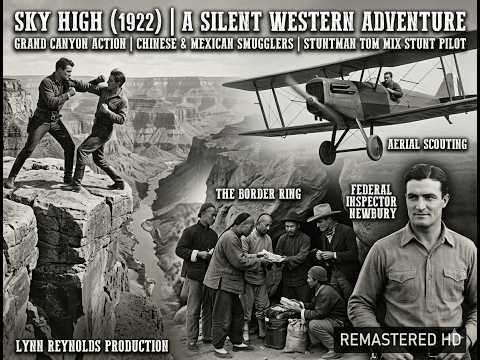
Sky High (1922) — One of Mix's most ambitious productions. Set at the Grand Canyon, with extensive location work and an aerial sequence. Among the finest visual achievements of his silent career.
Just Tony (1922) — Centers on Mix's horse Tony rather than on Mix himself. An unusual structural choice that worked because Tony was, by 1922, a genuine star.
Riders of the Purple Sage (1925) — Mix's adaptation of the Zane Grey novel. One of the most prestigious Westerns of the silent era.
The decline
Sound finished Mix as a star. His voice didn't film well (a fact he himself acknowledged), and his career trajectory through the early 1930s — at smaller studios, with diminished budgets — couldn't match his silent-era prominence. He left Hollywood in 1935 to run a circus. He died in a 1940 car accident in Arizona, struck in the head by a heavy aluminum suitcase containing his ashes — a memento mori he kept in his car.
The legacy
Mix's influence on the Western genre cannot be overstated. The 1950s singing cowboys, the John Ford-John Wayne Westerns of the 1940s and 50s, even the modern Western — all owe specific visual and structural conventions to Mix. Roy Rogers (himself Leonard Slye before Hollywood) modeled his entire screen persona on Mix's white-hat-and-named-horse template.
Where to start
Start with The Great K and A Train Robbery (1926) for the cleanest example of the Mix action style. Then try Sky High (1922) for the ambitious location work that distinguished his best Fox productions.