Tarzan Public Domain Films: The Pre-MGM Years
Before Johnny Weissmuller — the silent and early-sound Tarzan films now free to stream
Edgar Rice Burroughs introduced Tarzan in the 1912 magazine serial Tarzan of the Apes. The character was an immediate cultural sensation, and Hollywood started filming Tarzan stories almost immediately. The character has now appeared in over 80 feature films and serials — and a meaningful portion of the early entries are in the public domain.
The silent Tarzans
The first Tarzan film was Tarzan of the Apes (1918), starring Elmo Lincoln. The production was extremely successful — the film grossed over $1 million on a budget of $300,000 (enormous returns for 1918) — and immediately spawned sequels. Lincoln starred in The Romance of Tarzan (1918), a quickly-produced follow-up using leftover footage.
Several silent Tarzan films followed across the 1920s with different actors: Gene Pollar (The Revenge of Tarzan, 1920), P. Dempsey Tabler (The Son of Tarzan, 1920, a 15-chapter serial), and James Pierce (Tarzan and the Golden Lion, 1927). All of these silent Tarzans are now public domain through non-renewal.
The early sound era
The arrival of sound brought a new wave of Tarzan productions. The most notable was Tarzan the Tiger (1929), a 15-chapter serial starring Frank Merrill. The serial was originally produced silent and then partially redone with sound — an awkward transitional production, but historically significant as one of the earliest sound serials.
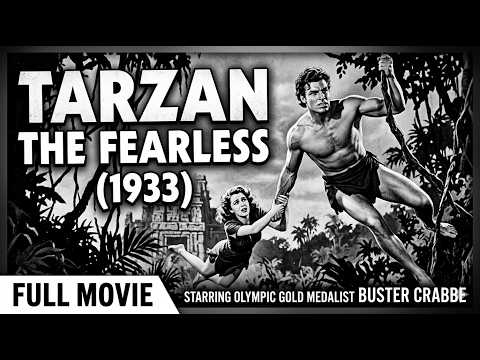
Tarzan the Fearless (1933) starred Buster Crabbe, fresh from his Olympic swimming gold medal. The 12-chapter Mascot Pictures serial was rushed into production to capitalize on MGM's huge success with Tarzan the Ape Man (1932). Crabbe's leaner, more athletic Tarzan was closer to Burroughs's original character — but Weissmuller's MGM Tarzan became the iconic one. Crabbe's serial is now in the public domain.
The New Adventures of Tarzan (1935) — a 12-chapter serial starring Herman Brix (later renamed Bruce Bennett). Independent production filmed largely on location in Guatemala. The serial's authentic jungle photography is striking, and the production was technically more ambitious than the MGM Weissmuller pictures of the same era. Brix's Tarzan was closer to Burroughs's intelligent, multilingual character. Also public domain.
The Weissmuller era
MGM's Johnny Weissmuller Tarzan films (1932–1948) defined the character for a generation. Tarzan the Ape Man (1932), Tarzan and His Mate (1934), and the subsequent series shaped popular perception of Tarzan as monosyllabic ("Me Tarzan, you Jane"), powerful, and elemental. Most of the MGM Weissmuller pictures remain under copyright. A few have lapsed: Tarzan and His Mate (1934) has a complicated rights situation that puts some prints in the public domain.
The RKO Weissmuller years
When Weissmuller's MGM contract ended in 1942, he moved to RKO and continued the role through 1948 with diminishing budgets. The RKO Tarzans — Tarzan Triumphs (1943), Tarzan's Desert Mystery (1943), Tarzan and the Amazons (1945) — are partially in the public domain through RKO's eventual collapse.
The Lex Barker and Gordon Scott eras
After Weissmuller, RKO continued the series with Lex Barker (1949–1953) and Gordon Scott (1955–1960). Several of these later Tarzans have slipped into the public domain through complicated post-RKO rights handling.
The essential public-domain Tarzans
Tarzan of the Apes (1918) — The original. Elmo Lincoln's performance is silent-era acting at its most physical. The picture's authentic Louisiana swamp locations stand in for the African jungle convincingly.
The New Adventures of Tarzan (1935) — Herman Brix's serial is the most faithful screen Tarzan to Burroughs's source material. Multilingual, intelligent, athletic. Worth seeking out.
Tarzan the Fearless (1933) — Buster Crabbe's serial debut. The road-not-taken version of the franchise.
Tarzan and the Trappers (1958) — A late Gordon Scott TV pilot edited into a feature. Public-domain status due to its TV-production origins.
Where to start
Start with Tarzan of the Apes (1918) to see where the franchise began. Then move to The New Adventures of Tarzan (1935) for the most ambitious and faithful pre-Weissmuller production. Together they show a Tarzan very different from the monosyllabic MGM version that has dominated popular memory.