How to Spot the Difference Between A-Westerns and B-Westerns
Budget, runtime, star power — the practical markers that tell you which side of the divide a film sits on
Read enough about classic Westerns and you'll repeatedly encounter the distinction between "A-Westerns" and "B-Westerns." The terms come from the studio system of the 1930s and 1940s, and they're more than marketing categories — they describe genuinely different filmmaking practices, audiences, and economics. Here's how to tell which side of the divide a given film sits on.
The original meaning
From the mid-1930s through the late 1940s, most American theaters ran double bills: an A-picture (the headlining feature) plus a B-picture (the shorter, cheaper supporting feature). The terms initially had nothing to do with quality — they described position on the bill. An A-Western was the headlining Western. A B-Western was the support.
The practical markers
1. Runtime
The single most reliable marker. A-Westerns ran 90-120 minutes. B-Westerns ran 55-65 minutes. If you're looking at a 60-minute Western from 1938, it's almost certainly a B-Western. If you're looking at a 105-minute Western from 1939, it's an A-Western.
2. Budget
A-Westerns were budgeted at $400,000 to $2 million. B-Westerns were budgeted at $15,000 to $80,000. You can usually see the difference: A-Westerns have more extras, better costumes, location shooting (especially Monument Valley after John Ford established it), and original orchestral scores. B-Westerns have smaller casts, stock costumes, back-lot "Western towns," and either no music or simple stock music tracks.
3. Star power
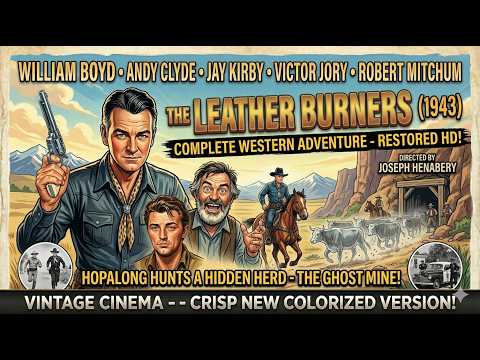
A-Westerns featured A-list stars — Henry Fonda, Errol Flynn, James Stewart, Tyrone Power, Joel McCrea, Randolph Scott, Glenn Ford. B-Westerns featured genre specialists — Roy Rogers, Gene Autry, Hopalong Cassidy, the Three Mesquiteers, Bob Steele. The exception is John Wayne, who started in B-Westerns (1932-1938) and graduated to A-Westerns after Stagecoach (1939). Watch his films chronologically and you can see the tier transition film by film.
4. Director
A-Westerns were directed by name directors — John Ford, Howard Hawks, Anthony Mann, William Wyler. B-Westerns were directed by genre specialists — Joseph Kane, Lesley Selander, R.G. Springsteen, William Witney. Some directors (like Wesley Ruggles or Allan Dwan) crossed back and forth, but most stayed in one tier.
5. Studio
A-Westerns came from the eight majors: MGM, Paramount, Warner Bros., 20th Century Fox, RKO, Universal, Columbia, United Artists. B-Westerns came from Republic, Monogram, PRC, Mascot, Tiffany, and dozens of other Poverty Row outfits. The exception again is Columbia, which produced both — its A-Westerns starred Glenn Ford or Randolph Scott; its B-Westerns starred Charles Starrett or Bill Elliott.
6. Plot complexity
A-Westerns had multiple plot threads, character development, romantic subplots that mattered to the story, and moral ambiguity. B-Westerns had a single clear plot (hero arrives in town → discovers corruption → fights villain → wins), perfunctory romance, and clean moral conclusions. The kid in the Saturday matinee audience needed to understand the story by minute 10.
7. Music
A-Westerns had original orchestral scores by composers like Alfred Newman, Max Steiner, or Dimitri Tiomkin. B-Westerns either used stock music libraries (the same generic Western cues showing up in dozens of films) or, in the singing-cowboy entries, integrated three to four musical numbers performed by the star with guitar.
The exceptions
A few films defied easy categorization. Stagecoach (1939) was made by John Ford with John Wayne — the perfect bridge case between A and B. The Searchers (1956) is unmistakably A-list. High Noon (1952) was technically a B-budget independent that punched above its weight and became one of the most celebrated Westerns ever made. The categories were never absolute — but for the vast majority of 1930s-1940s Westerns, the markers above will tell you which tier you're watching with maybe 95% accuracy.
What this means for our archive
Our archive is heavily weighted toward B-Westerns — because most A-Westerns are still in copyright with their original studios, while most B-Westerns from defunct Poverty Row outfits are now in the public domain. The result: you can watch a remarkably complete library of the B-Western universe for free, but you'll need a streaming subscription to MGM, Fox, or Warner Bros. catalogs for the A-Western equivalents. This is partly why classic-film fans tend to know B-Westerns far better than they realize — they're the ones that are actually available.