Shirley Temple's Public Domain Films
The biggest box-office star of the 1930s — and the handful of her pictures that escaped studio copyright
From 1935 through 1938, Shirley Temple was the most popular box-office star in the world — outdrawing Clark Gable, Joan Crawford, Gary Cooper, and every other adult Hollywood star at the height of their careers. She was 7 years old when she became the world's biggest star. She had been making films professionally since age 3. Her career across the 1930s reshaped how Hollywood made and marketed films for family audiences, and the cultural impact of her stardom is still being studied 90 years later.
The career arc
Temple was born in 1928 in Santa Monica, California. Her mother enrolled her in dance classes at age 3, and she began appearing in "Baby Burlesks" — short films that satirized adult-Hollywood productions using casts of preschool children. The Baby Burlesks were shocking by modern standards (the children performed in adult costumes and contexts) but launched Temple's screen career.
Fox Film Corporation (later 20th Century-Fox) signed Temple to a long-term contract in 1934. Stand Up and Cheer! (1934) gave her a featured musical number. Bright Eyes (1934) made her a star. By 1935 she was the highest-grossing performer in American cinema. She made approximately 4-6 films per year throughout the mid-1930s, with each picture grossing millions of dollars on production budgets under $250,000.
Now and Forever (1934)
Paramount Pictures production directed by Henry Hathaway. Temple co-stars with Gary Cooper and Carole Lombard. Cooper plays Jerry Day, a con artist whose discovery of his apparently abandoned daughter (Temple) gradually transforms his moral life. Lombard plays his romantic partner. The picture was a major commercial success and helped establish the "Temple transforms an adult" narrative template that subsequent films extensively imitated.
Now and Forever is in the public domain through Paramount's complicated post-1956 rights handling. The picture is one of Temple's earliest substantial roles opposite established adult stars and demonstrates how naturally she could share scenes with much more experienced performers.
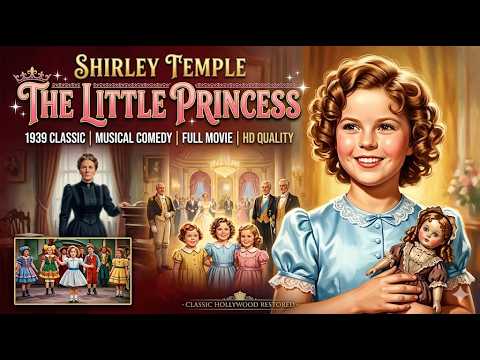
The Little Princess (1939)
20th Century-Fox production directed by Walter Lang. Based on Frances Hodgson Burnett's 1905 novel. Temple plays Sara Crewe, a wealthy English girl whose father (Ian Hunter) leaves her at a boarding school while he goes to fight in the Boer War. When her father is reported killed, Sara loses her wealth and is reduced to servant work at the school. The picture's emotional climax — Sara being reunited with her wounded father at a London hospital — is one of the most-cited Temple sequences.
The Little Princess was Temple's first Technicolor production. Fox invested heavily in the picture as a prestige showcase for their biggest star. The Technicolor cinematography (by William V. Skall and Arthur C. Miller) gives the picture distinctive visual richness. Public-domain status applies through Fox's failure to renew.
The Fox copyright
Most of Temple's mid-1930s peak productions — Bright Eyes (1934), The Little Colonel (1935), Curly Top (1935), Captain January (1936), Wee Willie Winkie (1937), Heidi (1937), Rebecca of Sunnybrook Farm (1938) — remain under Fox/Disney copyright. The Little Princess (1939) is one of the few major Fox Temple productions that lapsed into public domain.
The cultural significance
Temple's stardom is more than a curiosity. During the Depression, her films offered American audiences a particular form of cultural reassurance — a child star whose optimism and singing-and-dancing routines could substitute for an hour of personal hardship. Her films grossed an estimated $115 million in 1935 alone (over $2.5 billion in 2024 dollars). The financial significance of one child performer to an entire studio's operations was unprecedented before her career and has never been quite repeated since.
The career end
Temple's career began declining around 1939-1940. The Little Princess (1939) was a hit, but subsequent productions were less commercially successful. By 1940, Temple was 12 years old — past the cute-child-star peak. Fox sold her contract in 1940. She made a few films at MGM and other studios across the early 1940s but never recovered her mid-1930s commercial dominance.
She formally retired from acting in 1950 at age 22. Her adult career was entirely outside entertainment — she became a U.S. diplomat (Ambassador to Ghana, 1974-76; Ambassador to Czechoslovakia, 1989-92) and a Republican Party fundraiser. She died in 2014 at age 85.
The complicated legacy
Temple's career has been the subject of substantial subsequent reassessment. Modern scholarship has identified the often-uncomfortable elements of her stardom — particularly the sexualizing imagery in some early Baby Burlesks shorts, the cultural politics of her Black supporting players (particularly Bill "Bojangles" Robinson in The Little Colonel, 1935), and the family-audience moral framing that her films advanced. The legacy is complicated and continues to be studied.
Where to start
Start with The Little Princess (1939) — Temple's first Technicolor production and one of her most artistically substantial vehicles. Then move to Now and Forever (1934) for the earlier-career pairing with Gary Cooper and Carole Lombard that demonstrates Temple's range opposite established adult stars.