The Old Dark House Mystery Genre
How a 1925 Broadway play launched cinema's most enduring haunted-mansion formula

The Old Dark House mystery subgenre — a group of strangers stranded in a remote mansion during a storm where murders begin happening — was one of classical Hollywood's most reliable B-picture formulas. Originating in turn-of-the-century stage productions and crystallizing with the 1925 Broadway play The Cat and the Canary, the formula produced dozens of films across the silent, classical, and post-Code eras. Many are now in the public domain.
The formula
The Old Dark House mystery had specific recurring elements:
1. The remote location — typically a Victorian mansion in a stormy coastal setting, an isolated rural estate, or occasionally an Alpine lodge.
2. The forced gathering — usually triggered by a will reading, an inheritance claim, or a mysterious invitation.
3. The trapped guests — typically 6-10 characters who can't leave because of weather, transportation breakdown, or plot mechanics.
4. The supernatural framing — implied ghosts, hidden passages, suspicious household staff, and frequently a masked or hooded killer.
5. The rational resolution — almost always, the "supernatural" elements turn out to have human-criminal explanations.
The Cat and the Canary (1927)
The foundational sound-era Old Dark House film was Paul Leni's 1927 silent adaptation of John Willard's 1922 Broadway play. The picture established many of the visual conventions the subgenre would inherit: the looming candelabras, the cobwebbed staircase, the secret panels, the storm-flashes illuminating dark corridors. Universal Pictures produced; the film is now in the public domain.
The Cat and the Canary was remade multiple times: in 1930 as The Cat Creeps, in 1939 as a Bob Hope/Paulette Goddard comedy (Paramount, still under copyright), and in 1978 as a British production. Each adaptation reinforced the source material's status as the subgenre's canonical text.
The Old Dark House (1932)
James Whale's The Old Dark House (1932) — Universal's prestige horror production with Boris Karloff, Charles Laughton, Gloria Stuart, and Melvyn Douglas — gave the subgenre its name. The picture is more artistically substantial than the typical Old Dark House mystery: Whale's deadpan British humor anchored the picture through its more ridiculous moments, and the cast was substantially stronger than the subgenre's usual ensemble. Remains under Universal copyright.
The B-picture cycle
The 1930s and 40s saw an enormous flood of Old Dark House mysteries from Poverty Row and lower-budget studios. The formula was attractive: limited locations (one house), small casts (6-10 actors), tight runtimes (60-75 minutes), and an established audience expectation for the conventions. Production was cheap and fast.
Key public-domain B-picture entries:
The Bat (1926, silent; remade 1959) — Roland West's silent adaptation of Mary Roberts Rinehart's The Bat. A masked killer stalks a country estate during a will-reading gathering. The 1959 Vincent Price/Agnes Moorehead remake (covered in batch 3) is also public domain.
The Ghoul (1933) — British production starring Boris Karloff as an Egyptologist whose corpse rises from his tomb to recover a stolen jewel. The picture combines Old Dark House conventions with proto-mummy-film material. Public domain.
The Spider Returns (1941) — Republic serial that adapted the Spider pulp-magazine character into Old Dark House territory. 15 chapters of masked-villain pursuit.
The Black Widow (1947) — Republic serial. A criminal organization led by an exotic villainess kidnaps scientists. Strong Old Dark House sequences.
The Castle gimmick era
William Castle revived the Old Dark House formula in the late 1950s with theater-gimmick productions:
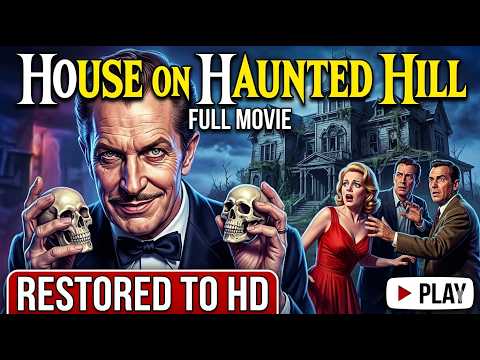
House on Haunted Hill (1959) — Vincent Price hosts a haunted-house party offering $10,000 to anyone who survives the night. The film's "Emergo" gimmick (a plastic skeleton flying out over the audience at the climactic moment) made it a national phenomenon. Public domain.
13 Ghosts (1960) — Castle's follow-up. A family inherits a haunted house. The "Illusion-O" gimmick used red-and-blue glasses to reveal ghosts that were otherwise invisible on screen. Partially public domain.
The Bowery Boys / East Side Kids variants
The Bowery Boys/East Side Kids franchise repeatedly returned to Old Dark House premises throughout the 1940s. Spooks Run Wild (1941), Ghosts on the Loose (1943), Spook Busters (1946), and others put the gang at haunted mansions for comic effect. All public domain.
The subgenre's decline
By the late 1960s, the Old Dark House formula had largely exhausted itself. The conventions had been parodied (Mel Brooks's Young Frankenstein, 1974, drew on Old Dark House visual templates), absorbed into other subgenres (slasher films inherited the trapped-victims structure), and abandoned by the major studios. Television absorbed the remaining audience — The Munsters (1964-66) and The Addams Family (1964-66) used Old Dark House visual conventions for sitcom comedy.
The recent revival
The 2010s saw a modest Old Dark House revival. Rian Johnson's Knives Out (2019) and its Netflix sequels (Glass Onion, 2022; Wake Up Dead Man, 2025) deliberately revived the formula for contemporary audiences. The trapped-guests structure, the will-reading premise, and the multiple-suspect dynamic all trace directly to the classical Old Dark House cycle.
Where to start
Start with The Cat and the Canary (1927) for the subgenre's foundational silent text. Then move to House on Haunted Hill (1959) for the William Castle gimmick-era version that best demonstrates how the formula could deliver pure entertainment value. The 1959 Vincent Price The Bat shows how the subgenre adapted to color-era horror production. Together they map the Old Dark House mystery from silent original through gimmick-era peak.