Flash Gordon TV (1954): The Space Hero Returns to Television
Steve Holland starred in 39 episodes of late-1950s sci-fi adventure based on Alex Raymond's comic-strip hero

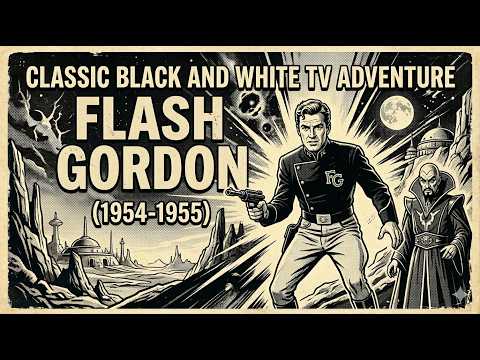
Flash Gordon (1954–1955) was a 39-episode American-French co-produced television series starring Steve Holland as Flash Gordon — the comic-strip space hero. The series was filmed in West Berlin and Marseille at relatively high production cost for 1950s TV sci-fi, and it occupies a fascinating intermediate position in screen sci-fi history. It came nearly two decades after the famous Buster Crabbe serials (1936-1940) and over two decades before the Star Wars era reignited interest in pulp space opera.
The Alex Raymond source
Alex Raymond launched the Flash Gordon newspaper comic strip in January 1934 as King Features Syndicate's answer to the popular Buck Rogers strip. Raymond's visual style was extraordinarily sophisticated — Art Deco architecture, fluid figure work, exotic alien designs, and distinctive Continental-classical references throughout. The strip ran continuously from 1934 to 2003 (long after Raymond's 1956 death in a Connecticut car accident) and spawned the Universal Pictures serials, paperback novels, and eventually the 1954 TV series.
The Buster Crabbe serial inheritance
Buster Crabbe's three Universal Flash Gordon serials (1936, 1938, 1940) were extraordinarily popular and defined screen Flash Gordon imagery for a generation (covered in batch 5). The 1954 TV series was conceived partly as continuation of the Crabbe-era serial tradition for the new television medium. Steve Holland was selected partly because he had a passing physical resemblance to Crabbe — the producers wanted continuity with the established visual brand.
The TV production approach
The 1954 series moved Flash Gordon decisively into the future. Where the 1936 serials had been set in the present (the rocket-ship technology was treated as imminent rather than historic), the 1954 TV series was set in the 31st century. Flash, Dale Arden, and Dr. Zarkov worked for the "Galactic Bureau of Investigation" (an inter-planetary law enforcement agency) and traveled to various planets to investigate threats. The format gave the writers maximum flexibility — different worlds, different alien species, different conflicts each week.
Steve Holland's Flash
Steve Holland was 29 years old when cast as Flash. He had been working as a model in New York (his face had appeared on hundreds of paperback covers) before being recruited for the TV series. Holland's Flash was less commanding than Crabbe's serial version had been — more youthful, more uncertain, more genuinely surprised by what he encountered. The interpretation suited the half-hour-episode format, which had less room for the imperial-hero gravitas the feature-length serials had supported.
Holland's career after Flash Gordon was largely limited to modeling work. He continued appearing on pulp paperback covers throughout the 1960s and 70s — he is the most-painted male model of the postwar publishing era. He died in 1997 at age 71.
The Continental production
The series was filmed in Berlin and Marseille — partly because production costs in Europe were lower than Hollywood, partly because European studios had different filming permits that allowed certain shooting practices unavailable in the U.S., and partly because the producers wanted to use European architectural and landscape exteriors as alien-planet backgrounds. The Continental production gives the 1954 Flash Gordon a distinctive visual texture — German Expressionist architectural backgrounds, Mediterranean coastal settings, and Continental-cast supporting performers.
The space-opera tradition
The 1954 Flash Gordon TV series was one of the few sustained American sci-fi TV adaptations between the 1939 Buster Crabbe Buck Rogers serial and the 1966 launch of Star Trek. The cultural space between pulp-magazine space opera and prestige TV sci-fi was largely empty during the 1950s and early 1960s, and Flash Gordon TV occupied a meaningful place in that landscape. The series's influence on subsequent space-opera television has been continuous but quiet — Star Trek's episode-of-the-week structure, the team-of-explorers premise, and the visit-different-planets format all have direct genealogy in Flash Gordon TV.
Essential episodes
The Return of the Androids — Robot-themed adventure that addresses classic sci-fi premises about artificial intelligence.
The Race Against Time — Time-travel and chase-narrative episode that demonstrates the format's range.
The Planet of Death — Threatening-alien-world episode with strong atmospheric production.
The Lure of Light — Mystery-investigation episode with sci-fi premises.
Why the series faded
The 1954 Flash Gordon TV series ran for one season and didn't get renewed. The reasons were largely commercial — the European production model was expensive to sustain, ratings were modest, and the show lacked the breakout cultural traction that would have justified expanded investment. By the late 1950s, the series had largely vanished from American TV schedules.
The Star Wars connection
George Lucas was 10 years old when the 1954 Flash Gordon TV series ran. He grew up watching both the Crabbe serials (in syndication) and the 1954 TV series, and has repeatedly cited Flash Gordon as a primary inspiration for Star Wars (1977). When Lucas couldn't acquire the Flash Gordon film rights in the early 1970s, he created an original property (Star Wars) that retained much of Flash Gordon's structure and visual approach.
Public-domain status
All 39 episodes are now in the public domain through complicated American-French rights handling. Our archive collects 14 episodes.
Where to start
Start with The Return of the Androids for one of the series's strongest single entries. Then sample The Race Against Time to see the format's range. Flash Gordon TV is an essential transitional text in screen sci-fi history — the bridge between the 1930s Buster Crabbe serials and the 1960s Star Trek era.