Flash Gordon Serials: Buster Crabbe's Three Space-Opera Marathons
Universal's 1936, 1938, and 1940 serials starred Olympic-medalist Buster Crabbe as the rocket-pilot hero who would influence everything from Star Wars to Guardians of the Galaxy

Flash Gordon's three Universal Pictures serials — produced in 1936, 1938, and 1940 — established the visual and narrative template for American space-opera cinema. All three serials starred Buster Crabbe as the rocket-pilot hero adapted from Alex Raymond's syndicated comic strip. The original 13-chapter Flash Gordon (1936) was Universal's largest-budget serial production to date — costing approximately $360,000, then an enormous figure for short-form weekly material. The serials' influence extends directly to Star Wars, Guardians of the Galaxy, and virtually every American space-opera production since.
The original 1936 serial
Flash Gordon (1936) ran 13 chapters and approximately 245 minutes total. The narrative follows polo-playing athlete Flash Gordon (Crabbe), scientist Dr. Hans Zarkov (Frank Shannon), and Dale Arden (Jean Rogers) as they pilot Zarkov's experimental rocket to the planet Mongo to confront Emperor Ming the Merciless (Charles Middleton) who is threatening Earth with destruction. The serial established core elements of subsequent space-opera storytelling: heroic Earth pilot, mad-genius mentor, romantic interest, alien empire ruled by tyrant, exotic landscapes populated by warring factions.
Flash Gordon's Trip to Mars (1938)
The 15-chapter sequel sent Flash, Dale, and Zarkov to Mars to investigate a beam of energy threatening Earth's atmosphere. The serial introduced the Clay People — clay-skinned subterranean Martians whose visual design directly influenced subsequent alien-creature conceptualization in 20th-century American sci-fi. The serial ran 299 minutes total.
Flash Gordon Conquers the Universe (1940)
The third serial returned to Mongo and the final defeat of Ming. The 12 chapters ran approximately 240 minutes. By 1940 serial production budgets were tightening; the third Flash Gordon was visibly less elaborate than the 1936 original, though Crabbe's lead performance and Middleton's reliably menacing Ming kept the entertainment value high.
The Buster Crabbe career arc
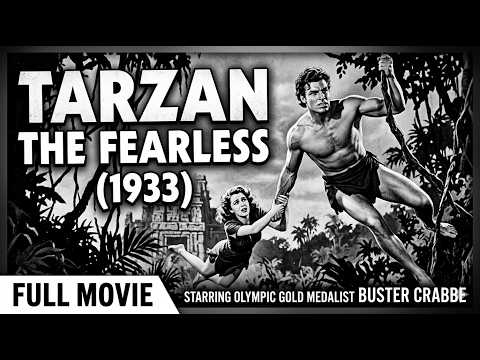
Buster Crabbe — who had won a gold medal in the 1932 Olympics 400-meter freestyle swimming event — became the defining serial-cinema lead of the late 1930s. His Flash Gordon performances combined athletic physicality with earnest dramatic seriousness in a way that anchored increasingly exotic narrative material. He also played Tarzan in Tarzan the Fearless (1933), Buck Rogers in Buck Rogers (1939), and dozens of other serial heroes through his career.
The Star Wars connection
George Lucas has repeatedly cited Flash Gordon as the direct origin of Star Wars. Lucas initially attempted to acquire the Flash Gordon rights to make his own Flash adaptation in the early 1970s; when that proved impossible, he developed Star Wars (1977) as an original property drawing heavily on the Flash Gordon template. The opening crawl, the lightsaber duels, the Death Star's similarity to Mongo's planetary throne room, the heroic-pilot-saves-the-galaxy narrative arc — all derive from Crabbe's Flash Gordon.
Public-domain availability
The 1936 Flash Gordon was rendered into the public domain through copyright-renewal lapses in the late 1960s. Both sequels followed for similar reasons. All three serials circulate freely as complete chapter-by-chapter productions or as condensed feature edits.
Where to start
For first-time viewers, the original 1936 Flash Gordon is the most accessible — the budget is highest, the cast is freshest, and the narrative is most coherent. Watch one or two chapters per sitting rather than attempting the full 245-minute marathon in one go. The serial format was designed for weekly exhibition.