Best Public Domain Silent Films You Can Watch Free
From The Great Train Robbery to Wings — the silent-era classics still available without subscription

The silent film era — from approximately 1895 through 1929 — produced some of cinema's most enduring works. The vast majority of silent productions are now in the public domain through age (copyright expiration) and/or non-renewal. The result is a richer free-cinema catalog than the sound era can offer — many of the foundational works of American and European cinema can be watched today without subscription or fee.
The foundational shorts
American narrative cinema essentially began with The Great Train Robbery (1903). Edwin S. Porter's 12-minute Edison Manufacturing production is foundational to the entire Western genre and to narrative film generally. The picture's cross-cutting between simultaneous actions, its outdoor location work, and its famous final shot (a bandit firing directly at the camera) established conventions that would define cinema for decades.
From The Great Train Robbery onward, hundreds of silent shorts established the visual conventions of subsequent cinema. Most are now in the public domain through age. The Library of Congress and various film archives maintain substantial collections.
The German Expressionist horror tradition
German silent horror created the visual vocabulary that subsequent American horror would inherit. The major works:
Nosferatu (1922) — F.W. Murnau's unauthorized Dracula adaptation. Foundational vampire cinema. Public domain through age.
The Cabinet of Dr. Caligari (1920) — Robert Wiene's distorted-set masterpiece. Foundational expressionist visual style. Public domain through age.
Dr. Jekyll and Mr. Hyde (1920) — John Barrymore's American horror landmark. Public domain through age.
Buster Keaton's silent comedy
Buster Keaton's independent silent productions are widely considered the high-water mark of American silent comedy. The major Keaton features (1923-1928) are mostly in the public domain through complicated post-MGM rights handling.
The General (1926) — Often cited as the greatest American silent film. Civil War-set chase comedy. Public domain through age. In our library.
Beyond action-comedy-maste/" class="auto-link">The General, Keaton's other silent classics — Sherlock Jr. (1924), Seven Chances (1925), Steamboat Bill, Jr. (1928) — are also widely available in public-domain prints.
The Wings aviation epic
Wings (1927) won the first Best Picture Oscar at the inaugural Academy Awards ceremony in 1929. William A. Wellman's WWI aviation epic featured authentic aerial combat photography that subsequent war films extensively imitated. Public domain through Paramount's complicated post-1956 rights handling. In our library.
The Tom Mix Westerns
Tom Mix was the most popular Western star of the silent era. His Fox-era features (1917-1928) are mostly in the public domain through age. The major Mix Westerns:
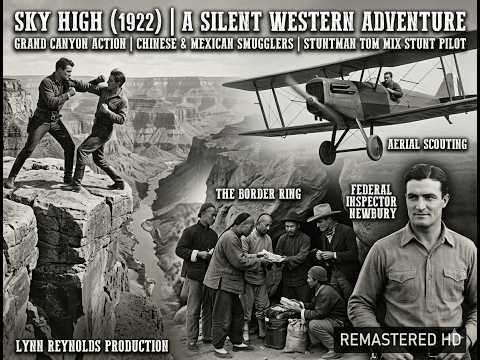
Sky High (1922) — Mix at the Grand Canyon, his most ambitious Fox silent. In our library.
Riders of the Purple Sage (1925) — Mix's adaptation of the Zane Grey novel. In our library.
The Great K & A Train Robbery (1926) — One of Mix's most polished late-silent features. In our library.
The Law and the Outlaw (1913) — Early Mix short showcasing his developing screen persona. In our library.
In the Days of the Thundering Herd (1914) — Mix's early frontier Western. In our library.
The Man From Texas (1915) — Mix's Selig Polyscope-era Western. In our library.
The Douglas Fairbanks Sr. swashbucklers
Douglas Fairbanks Sr.'s 1920s swashbuckler features established the entire genre. The major works:
The Mark of Zorro (1920) — Foundational masked-hero cinema.
Robin Hood (1922) — The Sherwood Forest hero on screen.
The Thief of Bagdad (1924) — Arabian-Nights spectacle.
The Black Pirate (1926) — Two-strip Technicolor pirate adventure.
All are in the public domain through age. Modern restorations provide substantially better quality than older transfers.
The Charlie Chaplin shorts
Chaplin's earliest film work (1914-1923) is in the public domain through age. The Mutual Film Corporation shorts (1916-1917) are widely considered his strongest single body of work — particularly The Vagabond, Easy Street, The Cure, The Immigrant, and The Adventurer. Most are freely available across streaming platforms.
Chaplin's feature films after 1923 (The Gold Rush, 1925; The Circus, 1928; City Lights, 1931) are mostly still under copyright through the Chaplin estate, but his early shorts are foundational silent comedy.
The silent-era restoration challenge
Silent film survival rates are tragically low. Approximately 75% of all silent feature films produced are now lost — destroyed in studio vault fires, deteriorated due to nitrate film degradation, or actively disposed of by studios that considered them commercially worthless. What survives is the result of dedicated archival preservation by institutions like the Library of Congress, MoMA, the British Film Institute, and various European cinematheques.
Modern restoration techniques (4K digital restoration from preserved 35mm elements) have substantially improved the visual quality of silent films. The Criterion Collection, the Cohen Film Collection, and various streaming services now provide silent films in restoration quality that exceeds what most contemporary 1920s audiences would have seen.
Where to start
If you've never watched a silent film, start with The General (1926) — Buster Keaton's masterpiece, 79 minutes, foundational Western comedy. From there, Nosferatu (1922) for the horror tradition, Wings (1927) for the prestige Hollywood standard, and any Charlie Chaplin Mutual short for the foundational silent comedy. Together these films map the silent era's range — from action comedy to gothic horror to wartime drama to physical comedy — and demonstrate why the silent era remains essential viewing for anyone interested in cinema history.

![The General (1926) [HD Restored] | Full Movie | Buster Keaton | Silent Action-Comedy Masterpiece](https://i.ytimg.com/vi/W1aZDV84_XA/hqdefault.jpg)